LJ CASE: The short-lived Slovene branch of the Tanjug press agency (1944-45) and the new »Federal Yugoslavia«
Introduction
What is a Telegraph agency?
Before we begin, we must first define what a telegraph agency is. A telegraph/press/news agency, is an organization that gathers, writes, and distributes news from around a nation or the world to newspapers, periodicals, radio and television broadcasters, government agencies, and other users. It does not generally publish news itself. news agency. Brittanica. [cited 17.4.2026] here.
Its primary function is the dissemination of objective, proven and concrete information, on which the general public and other media may rely upon.
What was the situation like in Slovenia before the Second World War?
Press agencies were no novelty in our corner of the world. Before the Second World War, the Kingdom of Yugoslavia, of which Slovenia was a part of at the time (an administrative entity going by the name Dravska banovina), had its own agency called Avala, which was a joint-stock company, however owing to the centralized structure of the state itself it only had one main office in Belgrade and a few correspondents in some major Yugoslav cities such as the one in Ljubljana which employed 8 people. Having been only responsible for the territory of Dravska Banovina, the section in Ljubljana published and delivered all of its material in Slovenian, mostly due to the fact that all the leading newspapers in Slovenia were published in Slovenian. Ljubljana had four daily newspapers in Slovenian: Jutro (Morning), Slovenec (Slovenian), Slovenski dom (Slovenian Home) and Slovenski narod (Slovenian Folk). See Simić (supra), page 74.
Many of these periodicals had their own sources from foreign nations, thus meaning that Slovenia, with its own journalistic tradition, was not entirely dependent on the centralized Belgrade office.


Inception in Jajce

World War 2 came to Yugoslavia in April 1941. The country soon fell to the invading Axis powers, who swiftly started to do away with the institutions of the old state, likewise on the 6th of June 1941 Avala was liquidated and its assets seized (See Simić (supra), page 81). Not long after the government surrendered, armed resistance formed within this area. The most prominent group were the Partisans, which encompassed all of the different nationalities of Yugoslavia and which were led by the Communist Party of Yugoslavia. The Slovenian resistance however had formed on its own in Ljubljana in the Vidmar Villa and encompassed not only communists, but also Christian socialists, cultural figures as well as the left wing of the Sokol movement. Thus, while forming a part of the Partisan resistance movement, it functioned more or less autonomously.

The idea for the Telegraph Agency of the new Yugoslavia came from the necessity of the Yugoslav resistance movement to inform its allies of the situation in the country as well as the need to establish its presence both internally and on the world stage by creating a formal press agency (Aleksić, D. Tanjug : 1943 – 1963. Tanjug. Beograd. 1963, page 4). This was decided on the 10th of November 1943, in the liberated territory of Jajce, where the second congress of AVNOJ (Anti-Fascist Council for the National Liberation of Yugoslavia) was held (Ibid., 6-9).

This congress also saw the representative of the more distanced Slovenian Liberation Front, including Edvard Kocbek. Its chief architect Moša Pijade, an extremely interesting individual in his own regard, stressed the need to inform the peoples of Yugoslavia as quickly as possible, as well as the need to
turn to the outside world, so that the foreign public (…) be informed as quickly as possible about the decisions made at the Second congress of AVNOJ in Jajce, which was to be the cornerstone of the new Yugoslavia.
This no matter how difficult the situation was. He also stressed the need to establish dislocated subsidiaries in each of the republics because of the poor connection between them (Ibid., pp. 4 and 20).



The inception of the Slovene branch and chronology

On the photograph above, you may find the circular letter issued by the Presidency of the Slovene National-Liberation Council stating the formation of the Slovenian branch of the Tanjug agency (National Archives of the Republic of Slovenia: SI AS 1643. Box 85). The problem with this statement is that it is false. The exact moment of inception of the Slovenian branch is hard to determine as multiple dates are given, however its existence, structure as well as it’s modus operandi were determined way before this circular was sent.
Well before the war started, the Communist party, which also headed the Slovenian resistance, had its own press, power structure and courier system since it was pushed into conspiracy during the interwar period, and in this way, when the war started, the Partisan movement could rely on an already existing infrastructure, hierarchy and expertise and of the Communist party’s press.
Before any formal branch, section, or institute was created, there existed a system of correspondents that wrote to their superiors about local important events, which were dislocated and scattered around different liberated territories. Some also informed about global events by listening to foreign radio stations such as; Radio Vestnik (Radio News, National Archives of the Republic of Slovenia: SI AS 1229. Box 24) and the Slovenski poročevalski urad (Slovenian Reporting Office, Ibid., box 57).

In terms of content, the partisan press followed the development of political and military events during the war. The first part is characterized by decentralization, and, given the war conditions, even plurality, which is linked to numerous local newspapers and regional editions of central newspapers. In the second part, after the second session of AVNOJ and the beginning of the construction of Slovenian and Yugoslav statehood, it was characterized by increasing centralization, the strengthening of the role of the Central Committee and Liberation Front (Jakomin Kocjančič (2021), T. Časopisje na Primorskem v letih 1941-1945 in njegova propagandna funkcija, Inštitut za novejšo zgodovino, page 30). It was the struggle of the Liberation Front to, when the conditions and maturity of the movement were sufficient, assert its presence in a territory which had two parallel governments, as there existed a Royal government in exile in London and later Kairo, to cement a new political entity and create a fully functioning government structure during an armed guerrilla conflict, all which prompted the creation of the Slovenian branch of TANJUG.



Declaration confirming the work of the Slovenian delegation at the Second Session of AVNOJ. The First Session of SNOS fully approves the work of the Slovenian delegation at the Second Session of the Anti-Fascist Council of National Liberation of Yugoslavia held on November 29, 1943, in Jajce. The Slovenian people have united with the peoples of Serbia, Croatia, Macedonia, Montenegro, and Bosnia and Herzegovina in a unified state community within a federal Yugoslavia, built on the principles of true people's democracy and national equality, freely, of its own will, on the basis of the right of every nation to self-determination, including the right to secession, but also to unite with other nations.

In March of the same year, the Information and Propaganda Section of the SNOS Presidency was formed as is seen in this document of the Official Gazzete of the Slovenian National Libration Council (National Archives of the Republic of Slovenia: SI AS 1643. Box 86). It is important to note that Jože Zemljak, an experienced pre-war journalist, who studied Slavic languages and literature, was elected as the chairman of this new section. He was not a member of the Communist party, but rather a Christian socialist, which meant that in his case (as in several others) merit overruled the party affiliation (National Archives of the Republic of Slovenia: SI AS 1643. Box 86, Zemljak Jože. Slovenska biografija. [cited 17.4.2026]. here).

Zemljak attended the conference in Jajce and on the photograph below we can see his remarks delivered at the conference. As one can immediately see, they are of a Christian socialist character (National Archives of the Republic of Slovenia: SI AS 1643. Box 86). This was the first crucial step in setting the groundwork for the new branch.

Jožko Zemljak spoke about the disappointment of the Slovenian people, especially Catholics, with the former Yugoslavia, where the gap between the former ideal and the later reality was becoming increasingly wider...
From January to March a delegation from Jajce, which included Moša Pijade came to the so-called Base 20, the seat of the Slovene National Liberation Government, which put a large emphasis on the creation of the Slovene branch of Tanjug and its importance. The situation was the same as on the 5th of May when a journalists’ conference in Metlika was held. It was there where journalists emphasised their dissatisfaction with how slow the process was going, especially regarding inadequate courier services (National Archives of the Republic of Slovenia: SI AS 1645). This conference was an important historic event and encompassed some of Slovenian brightest writers and future scholars.

Regarding the establishment of Tanjug, the problem of correspondence should be solved by including us (Društvo novinarjev/Society of journalists).
(Dušan Biber at the 1st conference of Slovenian journalists)
On the 17. June 1944 the Section released the following guide (National Archives of the Republic of Slovenia: SI AS 1229. Box 24). In it, it described in depth the new restructuring of the Section. At this point in my contribution, it is only important to note that it also included the Slovene branch of Tanjug.

SNOS Presidency June 17,1944
Information and Propaganda Section
To all district committees of the Liberation Front
On March 12, the SNOS Presidency established the Information and Propaganda Section. On March 12, the SNOS Presidency established the so-called Information and Propaganda Section.
The purpose of this section is to organize an information service and expand propaganda work, which has somewhat slackened at a time when we are busy building a national authority. To achieve this goal, the section has several departments (…) The section also includes a branch of Tanjug (Telegraph Agency of New Yugoslavia.
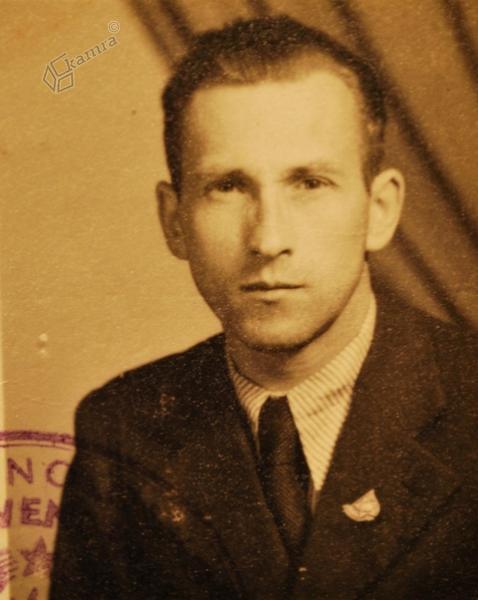
Around this time France Škerl – Bregar became the head of the new department, a doctor of geography and history, long-time writer of the Slovenian reporter (Slovenski poročevalec, National Archives of the Republic of Slovenia: SI AS 1229. Box 24., Đuro Šmicberger, (1988), Partizanska sedma sila. Tisk in novinarstvo v NOB. Ljubljana : Partizanska knjiga, pages 110 and 150) and attendee of the Metlika conference. He had ample experience in journalism and was well suited for the task. He was also a Christian socialist (Dr. France Škerl - razstava ob stoletnici rojstva. Kamra. [cited 17.4.2026]. Available here).

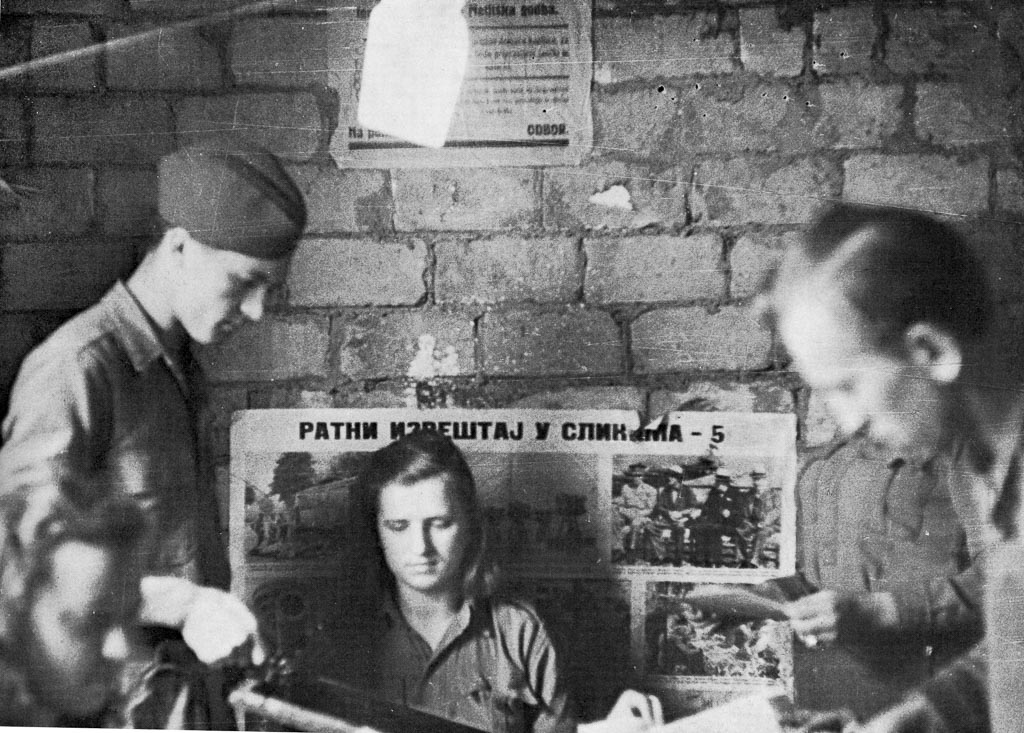
In its early stages the Slovenian reporter was interconnected and interwoven with several other periodicals. With all the different newspapers being situated at Base 20 in Kočevski rog, they frequently exchanged the information gathered amongst themselves (See Šmicberger (supra), page 110). From September 1943 till the end of the war, the Slovenian reporter in its two printing houses produced a total of 339.716 copies, all ranging from 4 to 8 pages (Ibid., 22). An incredible feat, when taken into account that this had occurred during an active guerilla war.


At this point the Section had already started to release its two bulletins “Poročila” (National Archives of the Republic of Slovenia: SI AS 1643. Box 84) and “Glasovi iz listov” (National Archives of the Republic of Slovenia: SI AS 1229. Box 57), which covered domestic affairs and foreign affairs respectively, effectively performing the task of a national press agency, apart from relaying its news to the outside world.

The purpose of these reports will be to inform the propaganda departments in the districts, various propaganda departments in the army, and various institutions in the IO or the SNOS Presidency about the general situation in Slovenia.

VOICES from the papers aims to provide internal information about how various foreign-language newspapers write about us, as well as various newspapers in our native language.
The change from the reorganisation can also be seen in two editions of Poročila (15. 16.) (National Archives of the Republic of Slovenia: SI AS 1229. Box 59.).

When the subsidiary became totally independent is not entirely clear. The aforementioned document states the 5th of October, however there is another document dated 2nd of October (National Archives of the Republic of Slovenia: SI AS 1643. Box 85, National Archives of the Republic of Slovenia: SI AS 1643. Box 84), informing the provincial, district, and county committees about the dissolution of the Information and Propaganda Section and the separation and creation of the Slovenian branch of Tanjug as an independent agency. However, the actual separation probably happened at the end of September as we can see from these editions of Poročila (54 and 55 dated 26. September; National Archives of the Republic of Slovenia: SI AS 1229. Box 59). The first one is released by the section, and the second by the Tanjug branch.

„According to the decision of the SNOS Presidency, all work of the existing information and propaganda section must be reorganized. All operations must be transferred to two new independent institutions: the Tanjug branch for Slovenia and the Commission for Agitation and Propaganda at the IOOF.”

The Slovene branch of Tanjug ended as it lived – in ambiguity. Poročila stopped being released in January of 1945 (National Archives of the Republic of Slovenia: SI AS 1229. Box 59), meaning that the branch lost its own bulletin with which it kept the Slovene audience informed without Central oversight.

These rules of February 1945 still mention the Slovenian branch of Tanjug; however, its activity had become very limited, as it could by now only have reported to the Central Tanjug (National Archives of the Republic of Slovenia: SI AS 1229. Box 24). In his article France Škerl mentions that the subsidiary was subject to reorganisation after May 1945, which is why we can probably safely say that’s the time when the branch was transformed into a correspondence office and thus lost its autonomy (Škerl, (1978) Podružnica Tanjuga za Slovenijo. Zgodovinsko društvo za Slovenijo: Zgodovinski časopis št. 1-2 pp. pages 130-132). The final message using Tanjug for Slovenia that I found, were the correspondences from April and May 1945 regarding the liberation of Ljubljana (National Archives of the Republic of Slovenia: SI AS 1229. Box 56)


Organisation, functionality and its changes
Purpose and organisation
We can tell that ever since its inception and subsequent reorganisations, the purpose of the section and later Tanjug branch were always the speedy transfer of objective independent information. This is evident from official and internal documents as well as the two mentioned periodicals (National Archives of the Republic of Slovenia: SI AS 1643. Box 84., National Archives of the Republic of Slovenia: SI AS 1229. Box 24., National Archives of the Republic of Slovenia: SI AS 1229. Box 57., National Archives of the Republic of Slovenia: SI AS 1229. Box 59).

The purpose of these reports will be to inform the propaganda departments in the districts, various propaganda departments in the army, and various institutions in the IO......Therefore, we ask all recipients of the "REPORTS„/„POROČILA“ to always report to us as quickly as possible, in addition to their critical comments, everything important that happens in their area, so that we can connect the entire Slovenian territory in terms of information and propaganda and also send information abroad.

Reports should be short, concise, and clear. They should be verified, i.e., they should be true and contain accurate information, including names, places, and dates. They should be sent immediately.


...internal information about how various foreign-language newspapers write about us. (...) We would like the letters to be as good as possible in terms of content and form.

...with reliability and realism.

Accuracy and speed are of paramount importance in the reporting service.

The principle of immediate and factual reporting must be applied consistently.

Some of our correspondents expect instructions and rules on how to write. Such instructions and rules could lead us into stereotyping, bureaucracy, and dull writing "by the rules." We do not want that.


Immediately… immediately… as soon as possible… now… directly… now…
In the early days of October, after the Branch became independent from the Section, the SNOS presidency had a debate regarding the purpose and organisation of this branch. In it they stated that the branch would be different form the former Avala, that it was to be independent and connected to the society of Slovenian journalists. It should focus on reliable information and should not be a propaganda centre, and that reporters should be reliable people with a feeling for journalism (National Archives of the Republic of Slovenia: SI AS 1229. Box 24).

Tanjug will certainly not be similar to the former Avala in terms of its organization, objectives, or composition, nor to agencies that are mostly privileged joint-stock companies in which government circles or the leaders of individual political parties, or more precisely, anti-popular cliques, hold a significant portion of the shares. Tanjug will be the official or semi-official agency of the new democratic and federal Yugoslavia

When selecting correspondents (Tanjug should acept and employ them in agreement with the Slovenian Journalists' Association), it is important that they are absolutely reliable and enjoy the full confidence of our authorities and political forums. Their skills, flexibility, affability—in short, their "journalistic instincts„ will ultimately determine the extent to which they will be favored by the authorities and how quickly they will dispatch information, even in extraordinary circumstances, at unofficial times and in unofficial places".

Tasks. In order for the branch to serve its purpose, it must organize its correspondence. Furthermore, it will draw information and news from official reports received from our regional authorities and from publications and radio broadcasts that are public but not accessible to all interested parties.

In detail, it is independent or linked to cooperation with the Slovenian Journalists' Association, particularly with regard to journalistic staff (members, correspondents) and the transmission of messages
Already the Information and propaganda section had several departments. In the above-mentioned document dated 17.6. it was written that it consisted of; the Department for Information Gathering, the Propaganda, the Radio, the Photography and the Distribution Department, and the Archives as well as Slovene branch of Tanjug as a department. In the document there is also a passage detailing how each section works, thus pointing to a rising professionalism and standardisation. The same can be seen in the “Work plan for the information and propaganda section (National Archives of the Republic of Slovenia: SI AS 1229. Box 24). After the separation, the later Branch inherited only the information gathering department, as can be seen in the earlier document from October 2nd (National Archives of the Republic of Slovenia: SI AS 1643. Box 84).
-Department for gathering information, organizing correspondence, editing and publishing reports, brochures, books, etc. -Radio department for listening to the radio, editing daily radio news, reviewing events and other publications. -Photo department. -Department for rallies and propaganda. -The department will also need to have its own archive and library. –Work plan


The division of tasks must be carried out in such a way that all propaganda, its organization, distribution of literature, and work of the photography sections within the framework of the Commission for Agitation and Propaganda, (…), while the collection of information and organization of the information service must be the responsibility of Tanjug i. e. the Branch for Slovenia - 2.10.1944
Sources of information
From the previously mentioned work plan we can see wherefrom the information was gathered (National Archives of the Republic of Slovenia: SI AS 1229. Box 24)
- from the IOOF Presidency in the form of correspondence;
- from the main headquarters and its propaganda department;
- from the Central committee;
- from its own correspondence structure -> this proved difficult because of mobilisation;
- from the (Central) Tanjug agency;
- and finally, from newspapers, books, brochures, leaflets, posters (Slovenian, Yugoslav, Allied, German, and Italian).

Here for example, we can find several news cutouts from British newspapers, delivered by the secret service to Base 20. It is of a particular interest to us, students of legal history, that the recipient, Marija Vilfan, the editor in chief of Slovenski Poročevalec, was the wife of the cousin of our former legal history professor (National Archives of the Republic of Slovenia: SI AS 1645). The material gathered clearly shows that the Allies assisted and collaborated directly with the Slovenian Liberation front.

Marija Vilfanova, chief editor of Slovenski Poročevalec from mid-1944. [cited 20.2.2026]. Available here


In one further example of a particular importance to us here below, we can find a typed text from a leaflet with the title (A clear word from London) in which Boris Furlan, who would later become dean of our faculty, calls upon the Home guard, as a representative of the royal government in London, to cease its collaboration with the Germans (National Archives of the Republic of Slovenia: SI AS 1643. Box 84).


Communication and technology
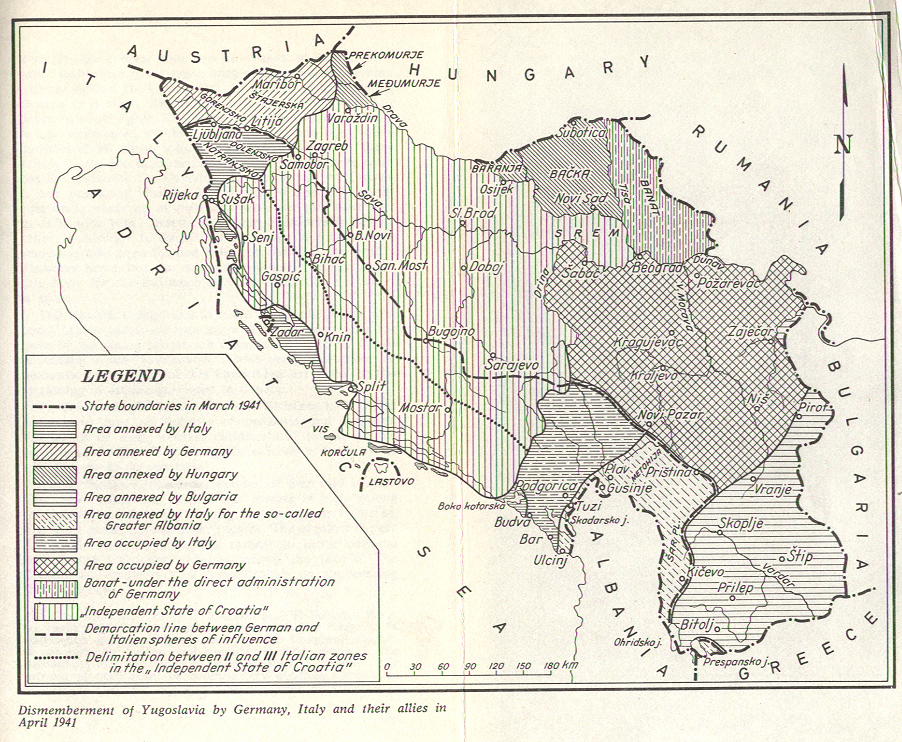
Despite the name “Telegraph agency”, the telegraph was not used as a means of communication for the most part. This is well explained by the fact that there was no continuity between the liberated territory, meaning that telegraph lines travelled through occupied territory and were frequently cut. We can see this by comparing these two maps.


The Telegraph Agency of New Yugoslavia (TANJUG) recently became an official state agency. Our branch is required to send news from Slovenia by telegraph to the Central agency, which then broadcasts it to the world as official reports...

Reports that need to be sent and published quickly should be sent to our branch in the form of radiograms via the Provincial Committees of the Liberation Front.

Despite difficult circumstances, we have also made good progress in terms of reporting speed. In the beginning, we relied almost exclusively on couriers to deliver reports, but today we have started using the telephone in many places, and we receive and transmit important news via radio. The outlook for the future is even brighter, when individual district correspondents will be able to communicate directly with their headquarters via their own radio stations, and the telephone and telegraph networks will also expand without limitation. The best guarantee of this are the successes we have achieved so far in the course of the struggle.

It would be good if the SNOS Presidency issued an order that our authorities should fully support the work of Tanjug and its correspondents in terms of travel, telephone and telegraph communications, and special courier services in important matters.
Conclusion

Sources and Bibliography
Sources
Archives of the Republic of Slovenia:
- SI AS 1643. Box 84, 85 and 86.
- SI AS 1645. Both boxes
- SI AS 1471. Box 19
- SI AS 1229. Box 24, 33, 55, 56, 57 and 59
Articles and literary sources
Jakomin Kocjančič, T. Časopisje na Primorskem v letih 1941-1945 in njegova propagandna funkcija. Inštitut za novejšo zgodovino. Ljubljana. 2021.
Comments
Post a Comment